 Blog Home
Buying Intent Keywords: How to Identify Them
Learn how to identify buying intent keywords that signal purchase-ready customers, boost conversions, and drive qualified traffic to your business

Our most recent articles
Most ecommerce brands burn cash chasing traffic that will never convert. They bid on broad keywords, rank for informational queries, and watch visitors bounce after a single page view.
Buying intent keywords are search queries that signal a shopper is ready to purchase. They separate browsers from buyers, curiosity from commitment.
A person searching "best running shoes" is researching. A person searching "buy Nike Pegasus 40 size 10" is one click from checkout.
This guide explains how to identify buying intent keywords, use them to attract high-intent shoppers, and connect them to the onsite behaviors that reveal who's actually ready to buy.
What are Buying Intent Keywords
Buying Intent Keywords, often referred to simply as "intent keywords," are search terms that indicate a user is actively considering a purchase, looking for a specific solution, or ready to take a commercial action. They are the most valuable type of keywords for businesses because they connect a company directly with consumers who are close to converting.
A buying intent keyword contains language that indicates a decision has been made. The shopper knows what they want. They're comparing options, checking availability, or looking for the fastest path to purchase.
What Makes a Keyword High Intent
- These queries often include action words. "Buy," "order," "discount," "coupon," "near me," "in stock," and "free shipping" all signal readiness.
- They also include specificity. Model numbers, SKU details, size, color, and brand names narrow the field. A search for "men's jacket" is exploratory. A search for "Patagonia Nano Puff jacket black medium" is transactional.
- High intent keywords also cluster around problem resolution. "Best price on," "cheapest," "where to buy," and "available now" suggest the shopper has finished their research and entered the decision phase.
The inverse is equally important. Queries like "what is," "how to," "guide," and "tips" are informational. They're valuable for top-of-funnel content, but they don't predict conversion.
Do not optimize for these without a clear path to purchase intent.
The Four Types of Buying Intent Keywords
High-intent queries fall into four categories, each with different conversion drivers and content requirements.
1. Transactional Keywords
These are the closest to purchase. They include words like "buy," "order," "purchase," "shop," and "price."
A shopper searching "buy organic coffee beans online" has moved past consideration. They're ready to transact. Your job is to remove friction and close the deal.
Transactional keywords convert fast, but they're also the most competitive. Every brand in your category is bidding on them. Winning requires a combination of price, availability, and trust signals.
2. Commercial Investigation Keywords
These sit one step before transaction. The shopper is comparing options, reading reviews, or checking specs.
Queries like "best wireless headphones under $200," "Sony WH-1000XM5 vs Bose QC45," and "top-rated espresso machines" fall into this bucket.
Commercial investigation keywords have high intent, but the shopper hasn't committed to a brand yet. Content that answers their comparison questions and positions your product as the best fit will win the click.
This is where buying intent becomes tangible. The shopper is actively evaluating. If you can prove value and reduce uncertainty, conversion follows.
3. Brand + Product Keywords
When a shopper searches for your brand name plus a product descriptor, intent is clear. They know you exist. They're checking availability, price, or specific variants.
"Nike Air Max 270 white size 9," "Patagonia Down Sweater sale," and "Lululemon Align leggings black" are all brand-specific, high-intent queries.
These keywords convert at the highest rate because the decision is already made. The shopper just needs confirmation that you have what they want, in stock, at a fair price.
If you're not ranking for your own brand + product combinations, you're leaving money on the table.
4. Location-Based Keywords
"Near me," "open now," "in stock nearby," and city-specific searches signal immediate intent. The shopper is ready to act, and geography is a deciding factor.
For brands with physical retail or local fulfillment, these queries are gold. For pure-play ecommerce, they're less relevant unless you're running geo-targeted ads or highlighting fast shipping.
But even online-only brands can capture location intent by emphasizing delivery speed and regional availability.
How to Find Buying Intent Keywords
Identifying high-intent keywords requires a combination of tools, competitor analysis, and customer behavior data.
1. Start With Your Product Pages
Your existing product pages are already ranking for some keywords. Pull a list of the queries driving traffic using Google Search Console.
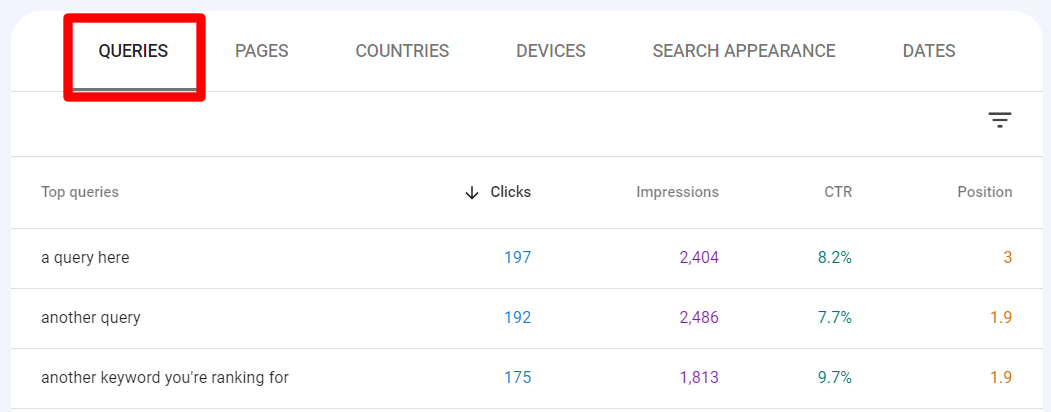
Filter by average position and click-through rate. Look for queries that include your brand name, product descriptors, or action words like "buy" or "order."
These are your baseline. If a query is already driving traffic, but you're ranking in position 5 or 6, optimizing that page could double conversions without increasing spend.
2. Use Keyword Research Tools
Tools like Ahrefs, SEMrush, and Google Keyword Planner let you filter by intent. Look for keywords with "commercial" or "transactional" intent tags.
Start with seed keywords related to your products. Plug in "buy [product]," "[brand] [product] price," and "[product] for sale." The tool will surface related queries with volume and competition data.
Pay attention to long-tail variations. "Best running shoes for flat feet under $150" may have lower volume than "running shoes," but the conversion rate will be 5x higher.
3. Analyze Competitor Keywords
Run a competitor analysis in Ahrefs or SEMrush. Identify the transactional keywords they're ranking for that you're not.
If a direct competitor is bidding on "buy [product] online" or "order [product] free shipping," they've validated that the keyword converts. You should be targeting it too.
Don't just copy their list. Look for gaps. Queries they're missing, or pages where they rank poorly, are opportunities to outposition them.
4. Mine Your Own Customer Data
The best intent signals don't come from keyword tools. They come from your customers.
Review support tickets, chat transcripts, and on-site search queries. What are people asking for? What language do they use?
If shoppers repeatedly search for "in stock," "available now," or specific SKUs, those are high-intent queries worth building content around.
This is where onsite behavior intersects with search behavior. A shopper who searches for a product, lands on your site, and then saves it to a wishlist is showing clear buying signals. That action is just as valuable as the keyword they used to find you.
Turning Keywords Into Conversions
Ranking for buying intent keywords is half the battle. Converting the traffic is the other half.
High-intent shoppers expect speed, clarity, and confidence. If they land on a page with slow load times, unclear pricing, or out-of-stock products, they bounce.
Your product pages need to answer the core questions immediately. Is it in stock? What's the price? How fast can I get it? What's the return policy?
Remove friction.
That's where intent signals become critical. A visitor who searches "buy Patagonia jacket," lands on your site, and adds the product to their cart is showing clear intent. Even if they don't complete checkout, you've captured the signal.
The question is: what do you do with it?
Capturing Intent That Doesn't Convert Immediately
Search keywords tell you what a shopper wants. Onsite behavior tells you when they're ready to act on it.
A visitor who searches a high-intent keyword, browses multiple product pages, and saves items to a wishlist is one step from purchase. They're not ready yet, but they're close.
The mistake most brands make is treating this as a dead end. The session ends. The shopper leaves. The intent is lost.
But intent doesn't disappear. It just needs a trigger.
A shopper who searches "buy leather boots size 9" and lands on an out-of-stock product page isn't a lost sale. If you can capture their email via a back in stock alerts form, you've preserved the intent.
The same logic applies to wishlists. A shopper who saves a product is telling you they want it, but not today. Maybe price is an issue. Maybe they're waiting for payday. Maybe they're comparing options.
Whatever the reason, you've captured the intent. Now you can act on it with price drop alerts, wishlist reminders, or personalized offers.
Latent shopper intent is worth $1.1 billion in uncaptured revenue across ecommerce. Most of that intent starts with a high-intent keyword. It just doesn't finish in the same session.
Why Most Brands Waste Their Best Traffic
The average ecommerce conversion rate is 2 to 3%. That means 97 out of 100 visitors leave without buying, even when they arrived via a high-intent keyword.
Most brands treat this as normal. They optimize their landing pages, run retargeting ads, and send abandoned cart emails. But the core problem remains: they're not turning window shoppers into buyers because they're not capturing the intent signals that predict purchase.
A shopper who searches "buy standing desk adjustable" and lands on your site is high intent. But if your site doesn't let them save the product, subscribe to price drop alerts, or get notified when their preferred variant restocks, you've built a dead end.
The traffic is good. The keyword is right. But the shopper has no path forward except "buy now," and most people aren't ready for that yet.
This is why optimizing for impulse buys alone leaves money on the table. High-intent shoppers aren't browsing casually. They're researching, comparing, and planning. They need time, not pressure.
At Swym, we are all about capturing that shopper intent and turning it into revenue, when they decide the time is finally right.
That's the signal worth acting on.
Capture the Products your Shoppers Truly Love
Swym Wishlist Plus lets shoppers save products they love, ensuring valuable customer intent is never lost and ready to convert.